Edward Scissorhands
Sunday, April 1, 2PM
Central Library
The film screening will be followed by a discussion led by Jamie Rocco, Ordway Center's Vice President of Programming and Producing Artistic Director. Mr. Rocco will also share interview clips of Matthew Bourne--the creative powerhouse behind the stage sensation.
Wednesday, February 28, 2007

LEARNING OPPORTUNITY
Interested in learning more about Web 2.0 and social networking software? Meredith Farkas has made webcasts and podcasts from her online class, Five Weeks to a Social Library, available online so that even those not enrolled can benefit.
--Andrea
--Andrea
Wednesday, February 21, 2007
Exciting resources!
I've been taking an information policy class and I've found out about a lot of great resources. Most of them have a strong focus on policy, so many people probably aren't interested in them. BUT here are a couple that could be helpful to our patrons:
http://www.opendemocracy.net This is a news site for global current affairs. You can look for articles, editorials, and forums on a particular region or topic. I really like that it has overviews of issues as well as more in-depth research, on the Iraq conflict for example.
http://www.gutenberg.org/wiki/Gutenberg:The_Audio_Books_Project Project Gutenberg, the public domain digitizing giant, is working with some organizations to provide downloadable audio books. I'm more familiar with librivox.org, but the three projects combined can provide a lot of titles--for free. How exciting! And they are looking for volunteer readers to make more books available, if you're looking for something to do.
-Katrina
Wednesday, February 14, 2007
Next Generation Leadership: Where Do We Go from Here?
Rachel Singer Gordon, author of “NextGen Librarian’s Survival Guide” and webmaster of LISjobs.com (among other accomplishments) talked about the difficulties inherent in managing and (on the flip side) being managed by people outside your own generation.
Understanding the problem, and how it can affect both the supervisors and supervisees was the easy part. Everyone working in the profession today is aware of the “graying” of the profession, and that we need to both attract and retain younger librarians to continue the profession into the 21st century. The difficulty comes when you start to map out what you can do that will effect that.
The exploration of generational issues was particularly well handled, but the part which dealt with managing nextgen librarians was (I thought) rather ineffective. Many of the suggestions made came from other articles which Rachel Gordon has written for LJ or other professional reading, and were less about intergenerational management than about good management in general.
Her main focus seems to be that if we don’t talk about the potential conflicts, we will fail to take advantage of the strengths of everyone on the team. We cannot ignore such all encompassing social issues (which affect so many people so deeply), and we need to examine what our own prejudices about each generation might be, so we may be better able to see how to change some of these beliefs. No one likes to be defined by an artificial stereotype, whether they are baby boomers, millennial generation or nextgen.
Many of the remedies mentioned are already being tried here at SPPL, i.e. vertical teams of employees working together on committees, collaboration across age lines, and attempting to instill a certain autonomy in the workplace.
The one thing I will carry away from this webinar is a new word (new to me, at least). The term is “neotony” and it means carrying youthful characteristics into adulthood. What a delightful concept! Let us hope that the characteristics being carried into adulthood are positive ones.
Doris
Understanding the problem, and how it can affect both the supervisors and supervisees was the easy part. Everyone working in the profession today is aware of the “graying” of the profession, and that we need to both attract and retain younger librarians to continue the profession into the 21st century. The difficulty comes when you start to map out what you can do that will effect that.
The exploration of generational issues was particularly well handled, but the part which dealt with managing nextgen librarians was (I thought) rather ineffective. Many of the suggestions made came from other articles which Rachel Gordon has written for LJ or other professional reading, and were less about intergenerational management than about good management in general.
Her main focus seems to be that if we don’t talk about the potential conflicts, we will fail to take advantage of the strengths of everyone on the team. We cannot ignore such all encompassing social issues (which affect so many people so deeply), and we need to examine what our own prejudices about each generation might be, so we may be better able to see how to change some of these beliefs. No one likes to be defined by an artificial stereotype, whether they are baby boomers, millennial generation or nextgen.
Many of the remedies mentioned are already being tried here at SPPL, i.e. vertical teams of employees working together on committees, collaboration across age lines, and attempting to instill a certain autonomy in the workplace.
The one thing I will carry away from this webinar is a new word (new to me, at least). The term is “neotony” and it means carrying youthful characteristics into adulthood. What a delightful concept! Let us hope that the characteristics being carried into adulthood are positive ones.
Doris
Tuesday, February 13, 2007
EVENT AT CENTRAL
Sunday, March 4, 2:00 p.m. - Central Library 4th Floor Meeting Room
My Autobiography, My Life: The Heartwarming Story of an Orphan Train Rider as told through the blocks of a quilt - Author and quilt maker Ann Zemke uses her book, They Named Me Marjorie: The Brave Journey of an Orphan Train Rider, and a very special quilt to tell the story of her grandmother's life, including her experiences as an Orphan Train Rider.
Barb M.
My Autobiography, My Life: The Heartwarming Story of an Orphan Train Rider as told through the blocks of a quilt - Author and quilt maker Ann Zemke uses her book, They Named Me Marjorie: The Brave Journey of an Orphan Train Rider, and a very special quilt to tell the story of her grandmother's life, including her experiences as an Orphan Train Rider.
Barb M.
Sunday, February 11, 2007
CUSTOMER SERVICE UPDATE
As part of Central’s Strategic Plan implementation of the goal of making library services more readily available, we will shortly begin providing a Library Greeter in the lst floor lobby during the busy lunch hour time (11:30-1:30). The Greeter will welcome patrons and provide basic directional information. The Greeter will have a laptop to do brief catalog searches as well as access information from our website.
Also, we will be increasing the “roving” aspect of our reference services. More libraries are offering roving reference with overwhelmingly positive response from patrons. “Passive roving” (walking around waiting to be questioned) is one option. Another option is “broadcast roving” (“Anyone here have a question?”) Most effective is the individual approach -- asking individual patrons something like “Are you finding what you’re looking for?”
Look for more information on the Greeter position and roving reference at Saturday morning meetings and your mailbox. In the meantime, if you have any questions, ask Phyllis, Greg, Doris or Barb S.
--Barb S.
Also, we will be increasing the “roving” aspect of our reference services. More libraries are offering roving reference with overwhelmingly positive response from patrons. “Passive roving” (walking around waiting to be questioned) is one option. Another option is “broadcast roving” (“Anyone here have a question?”) Most effective is the individual approach -- asking individual patrons something like “Are you finding what you’re looking for?”
Look for more information on the Greeter position and roving reference at Saturday morning meetings and your mailbox. In the meantime, if you have any questions, ask Phyllis, Greg, Doris or Barb S.
--Barb S.
Sunday, January 28, 2007
Exciting MN Book Awards event at Central on May 5th
On Saturday, May 5th, from 1 PM to 2:30 PM author finalists for the Minnesota Book Awards will be at Central greeting people and signing books. A list of the finalists is here.
Barb S.
Barb S.
Thursday, January 25, 2007
PHOTOS FROM THE PIONEER PRESS
Did you know that you can request photo reprints from the Pioneer Press? There is a link on TwinCities.com which takes you to an online form you can fill out with the date, edition, photographer's name and a description of the photo. This is submitted along with your contact info and the staff at the Pioneer Press will then check to see if that particular photo is available.
Not all photos will be: "Bear in mind that we do not own the copyright to everything that appears in the newspaper, and thus not all photographs are available for reprinting." However, if they find a photo matching your description, they will send you a thumbnail image for confirmation and you can then place an order.
These photos do not come cheap, but for those patrons doing ancestry research this may be an acceptable expense.
You can find the order form and pricing information here.
Laura
Not all photos will be: "Bear in mind that we do not own the copyright to everything that appears in the newspaper, and thus not all photographs are available for reprinting." However, if they find a photo matching your description, they will send you a thumbnail image for confirmation and you can then place an order.
These photos do not come cheap, but for those patrons doing ancestry research this may be an acceptable expense.
You can find the order form and pricing information here.
Laura
Wednesday, January 24, 2007
Copyright Information & Education
Laura discovered a great new resource for information about copyright, hosted by the U of M. Check out Copyright Information & Education.
I particularly like the decision map for determining fair use, when to ask for permission, etc.
Copyright info. used to be included on the Music & Song Lyrics page of our web links, but it has reached a critical mass, so I have given the topic its own page now.
--John
I particularly like the decision map for determining fair use, when to ask for permission, etc.
Copyright info. used to be included on the Music & Song Lyrics page of our web links, but it has reached a critical mass, so I have given the topic its own page now.
--John
Tuesday, January 23, 2007
Music Doings at Central
Denny, Sue and Bill have recently had the pleasure of going through the Field Music collection to make sure they are all in alphabetical order, prior to them being put into plastic sleeves to help preserve them.
Doris is currently going through the file drawers which are full (too full) of songbooks and music, and pulling out candidates for mending and/or bindery. We have run into a severe space crunch there, and hopefully this will make it possible for us to
a. Find the books/music we are looking for
b. Make room for the new songbooks and music which has been acquired but haven’t got a home yet.
We are also looking for a new method of shelving all those lovely songbooks which will help preserve them, make them easier to use, and more visible to the public.
If anyone knows of any companies dealing with shelving of music, please contact me.
Thanks, Doris.
Doris is currently going through the file drawers which are full (too full) of songbooks and music, and pulling out candidates for mending and/or bindery. We have run into a severe space crunch there, and hopefully this will make it possible for us to
a. Find the books/music we are looking for
b. Make room for the new songbooks and music which has been acquired but haven’t got a home yet.
We are also looking for a new method of shelving all those lovely songbooks which will help preserve them, make them easier to use, and more visible to the public.
If anyone knows of any companies dealing with shelving of music, please contact me.
Thanks, Doris.
Tuesday, January 09, 2007
New Resume Resources
Ever since the downtown Workforce Center closed, patron requests for resume help have increased. Here are some web sites that may help:
Creating Your Resume in Microsoft Word
Job Resume Templates
These sites are also available on the SPPL web page:
http://www.sppl.org/weblinks/jobs-careers.html
under Resumes-->Tutorials & Templates
Found via Librarian in Black
--Andrea
Creating Your Resume in Microsoft Word
Job Resume Templates
These sites are also available on the SPPL web page:
http://www.sppl.org/weblinks/jobs-careers.html
under Resumes-->Tutorials & Templates
Found via Librarian in Black
--Andrea
Friday, December 29, 2006
THE 80'S ARE BACK!
An updated version of Historical Statistics of the United States has arrived, the first new edition since 1993. It will live in the phone room. This source is handy for commonly-requested historical census information, especially that which is too recent for the Historical Census Browser web page.
City-level historical statistics can be hard to find, but Erin points out that there are sources for the population of St. Paul in the St. Paul Collection. Check in the St. Paul subject index under "Population".
City-level historical statistics can be hard to find, but Erin points out that there are sources for the population of St. Paul in the St. Paul Collection. Check in the St. Paul subject index under "Population".
Wednesday, December 20, 2006
CENTRAL STAFF FAVORITE READS OF 2006
Check out Central Staff's Favorite Reads of 2006, lovingly compiled by Erin.
Thursday, December 14, 2006
Send Email without Having Email
It sounds impossible, but it's not. Here's a cool site that allows you to send an email without having an email account: http://www.yousendit.com
You can attach files also. Of course, the recipient cannot reply to the email and access to the file only lasts 7 days.
You can attach files also. Of course, the recipient cannot reply to the email and access to the file only lasts 7 days.
Tuesday, December 12, 2006
African-American Romance Booklist
Do you have patrons looking for African-American romances? Check out The Colors of Love, a booklist by the Lincoln, Nebraska public library. Their Bookguide web site also has other booklists such as time-travelling romances, fiction for fans of online gaming, Native American detectives, and In Space No One Can Hear You Laugh (humorous science fiction).
Andrea
Andrea
Sunday, December 10, 2006
Central Book Club
Here are the upcoming titles for the Central Library Book Club which meets the first Monday evening of the month at 7 PM in the Meeting Room:
January 1st New Year's Day - no meeting
February 5th Simon's Night by Jon Hassler
March 5th My Name is Red by Orhan Pamuk
April 2nd The #1 Ladies Detective Agency by Alexander McCall Smith
May 7th The Things They Carried by Tim O'Brien
Anyone interested in moderating or contributing to the discussion for any of these titles should contact Barb S.
January 1st New Year's Day - no meeting
February 5th Simon's Night by Jon Hassler
March 5th My Name is Red by Orhan Pamuk
April 2nd The #1 Ladies Detective Agency by Alexander McCall Smith
May 7th The Things They Carried by Tim O'Brien
Anyone interested in moderating or contributing to the discussion for any of these titles should contact Barb S.
Culture of Poverty Workshop
This was a 2 part workshop which had more eye-opening moments than I can ever remember experiencing at a learning event presented by MELSA. The workshop began with Jodi Pharr, a chaplain and certified critical debriefer for the St. Paul Police department, talking to us about the course itself, and what she hoped to accomplish during the workshop. She hoped to bring us to an understanding of the role our culture plays in creating and maintaining classes within our society, and how to affect change within this model.
To that end, we (meaning the class and Jodi herself) created what she called a “mental model” of poverty, which centered on the forces that drive people who are in poverty. The driving forces are centered around relationship and survival, rather than the equivalent middleclass worldview which is ruled by work and achievement. Using many great anecdotes about her own and other people’s experiences, Jodi was able to helpus understand what this entailed.
For example, how many times have you had a patron ask you for a particular librarian and be unwilling to “settle” for whoever was on duty? If your relationship is with a particular librarian (however tentative), why would you settle for someone you had no relationship with? Many of those in generational poverty are unwilling to deal with those with whom they have no relationship, since it rarely profits them to do so, and can be both painful and unrewarding to even try. So, building a relationship is paramount in any ongoing contact. For example, if “Pete” is told that he owes fines and that he will be unable to check out, it may not faze him in the least. However, if you know that “Pete” has a little brother who uses his card to help him do his homework, and you relate the loss of the card’s privileges to the inability of the little brother to use the library, you may get a totally different response! This is the beginning of understanding how relationship governs the lives of those in generational poverty.
Authority figures are not viewed in the same way as the middle class would, either. Just because “we” say something, doesn’t make it relevant in the life of someone who may not have the resources that are available to most of us. If, for example, you are asking a woman to pay a fine in order to be able to check out, and she is looking at the last $4 in her wallet, it is unlikely that she would choose to pay a library fine over getting food for her family. In fact, I know of no-one who would reasonably ask anyone to make such a choice. However, lesser choices are also clearly weighted toward the family and the survival of that family, through whatever means necessary. As noted before, if a relationship is in conflict with the needs of an institution (say, the library), guess who’s going to “win”?
Generational poverty is also matriarchal in nature, as the male contingent is often not in a position to take the kind of daily responsibility that the middle class assumes would be “normal. In my handouts, I have a diagram of a “family” which gives you a fair idea of how convoluted some family relationships can become in this type of poverty. In fact, I’m not even sure I would be able to do it justice in narrative form at this point. If anyone who took the workshop would like to respond to this posting with both diagram and explication, please do .
So many of the points Jodi covered over the 2 days relate to communication and how it differs both among peers and between classes, that I will simply give one example here. Jodi posited a situation in which both a middle class person and a person from generational poverty were giving a description of a crime witnessed by both parties. In the case of the middle class witness, the description of what they saw was linear, formal and had a clear plot line. In the second decription, it was casual, with no clear cut beginning or end, not chronological tolerant of what the middle class would call interruptions. I won’t even try to duplicate it here, let’s just say “you had to be there”.
Even as we laughed, we were learning.
I will end this ramble with a question that was asked at the beginning of this workshop by Jodi, talking about her clients:
“If you did everything your caseworker told you to do, got a job and kept it for a year, never missing a day of work, how much closer (if at all) would you be to being out of poverty at the end of that year than you were at the beginning?”
The answer (according to Jodi) is you would not be any closer. One of my favorite handouts in the three ring binder (which will be in the FYI basket on the 4th floor staff area) is germain to the question and the answer. It is called Key Points and covers some of the more salient points covered during this workshop:
Poverty is relative.
Poverty occurs in all races and in all countries.
This workshop focuses on economic diversity, not racial or cultural diversity.
Economic class is a continuous line, not a clear-cut distinction.
Generational poverty and situational poverty are different.
This work is based on patterns. All patterns have exceptions.
An individual brings with him/her the hidden rules of class in which he/she was raised.
Schools and businesses operate from middle-class norms and use the hidden rules of middle class.
For our clients to be successful, we must understand their hidden rules and teach them the rules that will make them successful at school, at work, and in the community.
We can neither excuse persons form poverty nor scold them for not knowing; as professionals we must teach them and provide support, insistence, and expectations.
In order to move from poverty to middle class or middle class to wealth, and individual must give up relationships for achievement (at least for some period of time).
We cannot blame the victims of poverty for being in poverty.
We cannot continue to support stereotypes and prejudices about the poor.
In summary, if they ever bring her back, for goodness sake…..GO! It was worth it.
Doris
To that end, we (meaning the class and Jodi herself) created what she called a “mental model” of poverty, which centered on the forces that drive people who are in poverty. The driving forces are centered around relationship and survival, rather than the equivalent middleclass worldview which is ruled by work and achievement. Using many great anecdotes about her own and other people’s experiences, Jodi was able to helpus understand what this entailed.
For example, how many times have you had a patron ask you for a particular librarian and be unwilling to “settle” for whoever was on duty? If your relationship is with a particular librarian (however tentative), why would you settle for someone you had no relationship with? Many of those in generational poverty are unwilling to deal with those with whom they have no relationship, since it rarely profits them to do so, and can be both painful and unrewarding to even try. So, building a relationship is paramount in any ongoing contact. For example, if “Pete” is told that he owes fines and that he will be unable to check out, it may not faze him in the least. However, if you know that “Pete” has a little brother who uses his card to help him do his homework, and you relate the loss of the card’s privileges to the inability of the little brother to use the library, you may get a totally different response! This is the beginning of understanding how relationship governs the lives of those in generational poverty.
Authority figures are not viewed in the same way as the middle class would, either. Just because “we” say something, doesn’t make it relevant in the life of someone who may not have the resources that are available to most of us. If, for example, you are asking a woman to pay a fine in order to be able to check out, and she is looking at the last $4 in her wallet, it is unlikely that she would choose to pay a library fine over getting food for her family. In fact, I know of no-one who would reasonably ask anyone to make such a choice. However, lesser choices are also clearly weighted toward the family and the survival of that family, through whatever means necessary. As noted before, if a relationship is in conflict with the needs of an institution (say, the library), guess who’s going to “win”?
Generational poverty is also matriarchal in nature, as the male contingent is often not in a position to take the kind of daily responsibility that the middle class assumes would be “normal. In my handouts, I have a diagram of a “family” which gives you a fair idea of how convoluted some family relationships can become in this type of poverty. In fact, I’m not even sure I would be able to do it justice in narrative form at this point. If anyone who took the workshop would like to respond to this posting with both diagram and explication, please do .
So many of the points Jodi covered over the 2 days relate to communication and how it differs both among peers and between classes, that I will simply give one example here. Jodi posited a situation in which both a middle class person and a person from generational poverty were giving a description of a crime witnessed by both parties. In the case of the middle class witness, the description of what they saw was linear, formal and had a clear plot line. In the second decription, it was casual, with no clear cut beginning or end, not chronological tolerant of what the middle class would call interruptions. I won’t even try to duplicate it here, let’s just say “you had to be there”.
Even as we laughed, we were learning.
I will end this ramble with a question that was asked at the beginning of this workshop by Jodi, talking about her clients:
“If you did everything your caseworker told you to do, got a job and kept it for a year, never missing a day of work, how much closer (if at all) would you be to being out of poverty at the end of that year than you were at the beginning?”
The answer (according to Jodi) is you would not be any closer. One of my favorite handouts in the three ring binder (which will be in the FYI basket on the 4th floor staff area) is germain to the question and the answer. It is called Key Points and covers some of the more salient points covered during this workshop:
Poverty is relative.
Poverty occurs in all races and in all countries.
This workshop focuses on economic diversity, not racial or cultural diversity.
Economic class is a continuous line, not a clear-cut distinction.
Generational poverty and situational poverty are different.
This work is based on patterns. All patterns have exceptions.
An individual brings with him/her the hidden rules of class in which he/she was raised.
Schools and businesses operate from middle-class norms and use the hidden rules of middle class.
For our clients to be successful, we must understand their hidden rules and teach them the rules that will make them successful at school, at work, and in the community.
We can neither excuse persons form poverty nor scold them for not knowing; as professionals we must teach them and provide support, insistence, and expectations.
In order to move from poverty to middle class or middle class to wealth, and individual must give up relationships for achievement (at least for some period of time).
We cannot blame the victims of poverty for being in poverty.
We cannot continue to support stereotypes and prejudices about the poor.
In summary, if they ever bring her back, for goodness sake…..GO! It was worth it.
Doris
Sunday, December 03, 2006
125th CELEBRATION
As we all know, the Friends are working on the 125th celebration next year. One idea is to make lists e.g. 125 reasons to go to the library....125 librarians and their favorite books.....125 Minnesota celebrities and their favorite books etc. Barb M.'s idea is 125 unusual reference questions. Anyone with ideas for the "125 list project" or anyone wishing to work on the project should contact Barb S.
IF YOU ANIMATE IT
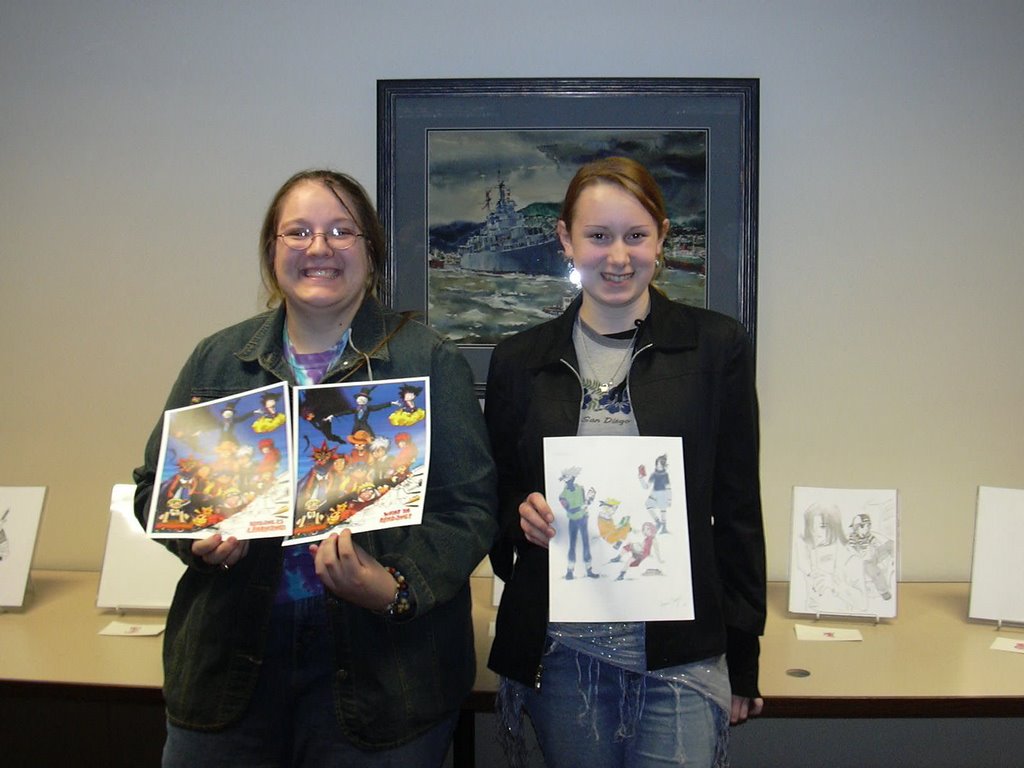
Teen Read Week. Those three daunting words. If you’ve ever lived with a teen, worked with a teen, or even just walked past a teen, you know that there can be a tendency toward introversion and surliness. Am I exaggerating? Yes. And no.
So when you ask a group of bookish librarians to plan a Teen Read Week event, is there a risk that their introversion and tendency toward surliness will clash with that of their intended audience and result in a less-than-explosive program? Maybe.
But not this year.
This year, we assembled the A-Team of Teen Read Week committees: Hannibal (Barb S.), B.A. (Andrea), Face (Kim F.) and Murdock (me). Together we managed to produce a knock-your-socks-off event using only a bucket, a few pieces of wire and an allen wrench. Okay, not really, but we did have a limited budget and only a short period of time in which to plan our program.
So how did we get 45 teens to come to the Central library on a beautiful Saturday afternoon, you might ask. Well, I’ll tell you. Anime. Yes, that’s right. And pocky.
It turns out pocky is a huge draw. Who knew?
For those of you who are not in the know (that category included me a few weeks ago), pocky is a Japanese treat. It’s like sticks of cookie dipped in frosting. Chocolate, strawberry, green tea (yes, green tea—it tastes a little like banana)…they were all a big hit. Pocky turned out to be the perfect accompaniment to Andrea’s DJ-style mix of Japanese pop and anime music, Carl’s anime caricatures (dare we say—AniME), and the judging of our poster contest.
Teens throughout the city were invited to submit entries to our READ poster contest. We received eight incredible drawings of anime and/or manga characters reading books. The winning drawings (we had two winners!) are being made into READ posters which will be on display here at Central, and the design of our runner-up will be made into bookmarks.
Shortly after the pizza arrived (that’s right, more food), we showed Fullmetal Alchemist: The Movie and generally made a huge mess of the carpet with ground-in popcorn and candy. Carl continued to draw throughout the movie, even though it was dark, and Andrea and I tallied the votes for the poster contest.
After a small ceremony announcing our contest winners and handing out fabulous prizes, our visiting teens headed home, bellies full and caricatures in hand, but not before asking, “When will you do this again?”
The Teen Read Week Committee would like to extend a heartfelt thank you to everyone who helped us in this endeavor, especially Carl, Karen S., Phyllis, Debbie, Joanna, Keiko, John L., Therese, Hans, Paul, Kathy C. and Marcus. We couldn’t have done it without you!
--Laura
Thursday, November 30, 2006
Katherine Lanpher
I went to see Katherine Lanpher do a music-accompanied reading from hernew book "Leap Days: Chronicles of a Midlife Move" at the Fitzgerald Theater. As you may know, she was a columnist for the Pioneer Press, then the host of Midmorning on MPR and then left MN to work with Al Franken on his radio show in NY.
The book is about her decision to move from St. Paul, her long-time,beloved home town, to NY, where she know nobody but a few of the people she was going to be working with, and her growth and adjustment in her new life. She was very entertaining, and the book sounds like it'll probably be good.
Katherine Lanpher is pretty popular here. I tuned into her being interviewed by Gary Eichten on Midday while she was in town for thereading, and the audience's response to her was amazing.
We currently have 35 holds on 10 copies of the book.
Melissa.
The book is about her decision to move from St. Paul, her long-time,beloved home town, to NY, where she know nobody but a few of the people she was going to be working with, and her growth and adjustment in her new life. She was very entertaining, and the book sounds like it'll probably be good.
Katherine Lanpher is pretty popular here. I tuned into her being interviewed by Gary Eichten on Midday while she was in town for thereading, and the audience's response to her was amazing.
We currently have 35 holds on 10 copies of the book.
Melissa.
Subscribe to:
Posts (Atom)